4 mins
The Google SRE Chapter 1 — Introduction
Why This Series
When Google's "Site Reliability Engineering" came out in 2016, it was one of the most candid accounts yet published of how a company actually keeps its production systems running. Ten years have passed since then. I read the book — and the two that followed it — at different points over the years, taking notes along the way, and I've since put a lot of it into practice in my own work. Now I want to walk through it chapter by chapter and ask two questions at once: what did the book actually say, and where does that idea stand in 2026? I'll bring my own experience into it too, so the more academic parts get grounded in problems we deal with day to day. Hope you enjoy the read.
The opening chapter, simply called "Introduction," reads like the book's manifesto.
The Sysadmin Model's Breaking Point
Google opens by describing a familiar setup: a company builds a service, then hires a separate "operations" team to keep it running. That team watches over the system and jumps in when something breaks usually by hand, one script or one command at a time.
The book points to two cracks in this model that, in hindsight, were always going to widen:
It doesn't scale. As a system grows, the number of people needed to keep it running grows right along with it. That's mathematically unsustainable. if a service gets ten times bigger, the ops team is supposed to get ten times bigger too.
The incentives are pointed in opposite directions. Developers want speed and new features. Operations wants stability, because from where they sit, every change is a risk. That tension is real, and most organizations try to paper over it with heavy approval processes which mostly just slows everyone down.
Google's Answer: SRE
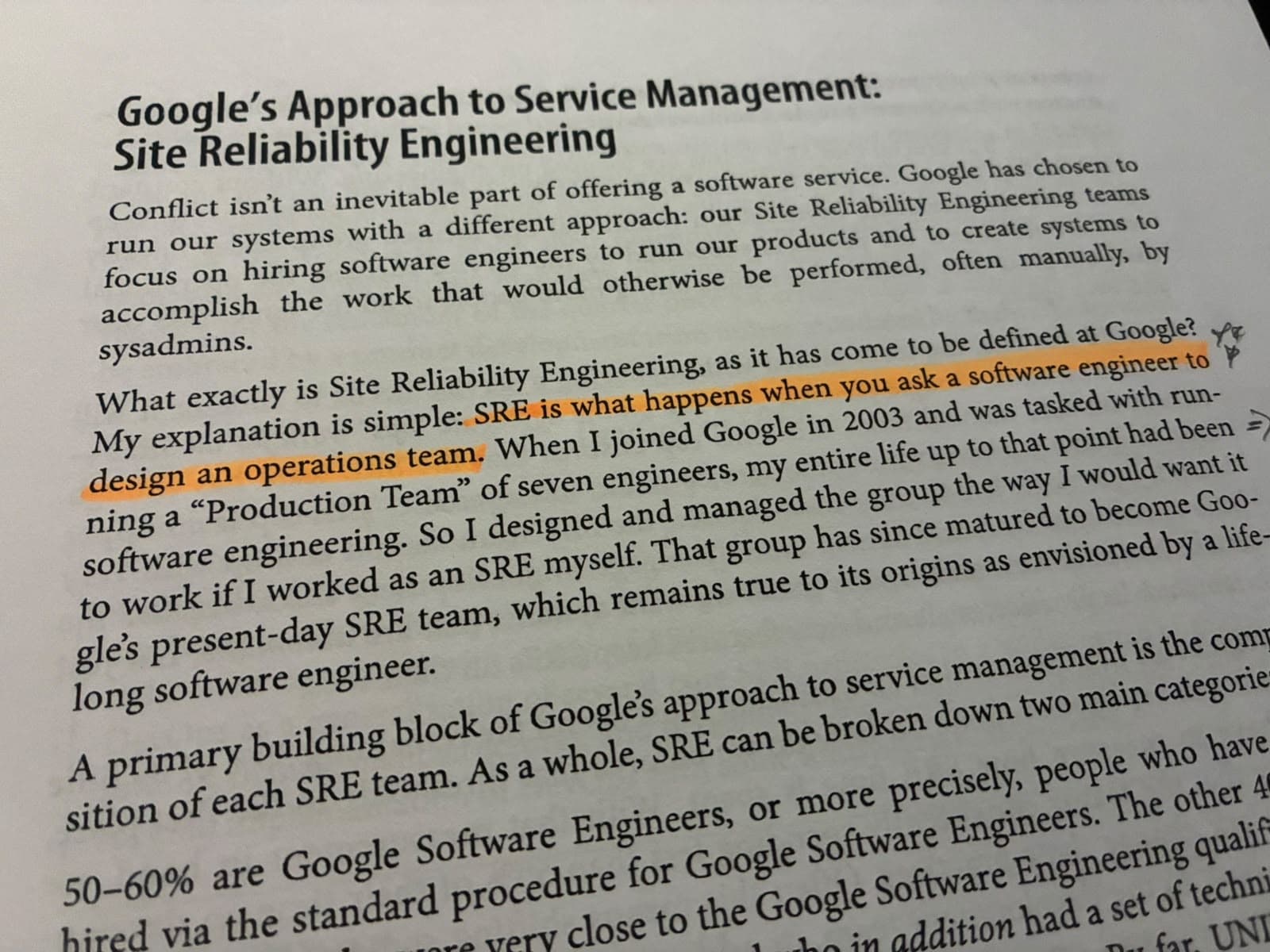
The book's most-quoted line is really its answer to that exact problem: "SRE is what happens when you ask a software engineer to design an operations team." Instead of handing operations to traditional sysadmins, you hand it to software engineers, who naturally reach for automation, scripting, and treating the system itself as code.
And here Google draws a hard line, not a soft suggestion: SREs should spend no more than 50% of their time on operational work — what the book calls "toil," meaning repetitive, automatable work that doesn't add lasting value. The other half is meant for engineering: building tools, fixing root causes, making the toil disappear for good. This isn't a nice-to-have. It's a design constraint.
Reading It Through a 2026 Lens
Ten years later, the chapter's core argument holds up surprisingly well but the landscape around it has shifted quite a bit.
What's aged perfectly: The dev-versus-ops tension never went away, it just changed its name. The platform engineering wave that took off after 2022 — with its "Golden Paths" and "Internal Developer Platforms" — is really just the next chapter of the same idea: turn operations into something engineered and self-service rather than something staffed. Error budgets and toil have become industry vocabulary at this point; anyone working with Kubernetes, Terraform, or Crossplane today just assumes these concepts without a second thought.
What Google couldn't have seen coming: In 2016, "automation" mostly meant writing scripts. Today a whole layer of it runs on AI — anomaly detection, automated root-cause analysis, "AI on-call copilot" products that are trying to cut toil down even further. That's a genuinely new tool in service of the book's 50% rule, but it comes with a new risk attached: trusting an AI's judgment more than we should.
System complexity has also grown by orders of magnitude. What counted as a "distributed system" in 2016 looks almost quaint next to today's mix of microservices, Kubernetes, multi-cloud, and serverless. If anything, this doesn't undercut the book's thesis it reinforces it. The scaling problem it described didn't ease up over the decade; it compounded.
One more thing worth noting: when the book came out, SRE still carried a bit of a "this only works at Google's scale" reputation which is exactly why the follow-up Workbook, in 2018, opens by trying to dispel that idea. By 2026, SRE practices have become everyday work even at mid-sized companies, and even at the level of independent consulting.
Closing Thoughts
Chapter 1 is really a philosophical case for why SRE needs to exist at all. Looking back after a decade, the diagnosis — that the old sysadmin model can't scale still holds, and so does the proposed fix: bring engineering discipline into operations. What's changed is mostly the tooling (AI, platform engineering) and the scale of the problem itself (system complexity, and how widely SRE has spread).
Next time, I'll cover Chapter 2 Google's production environment, seen through an SRE's eyes.
Thanks for reading.